Marveling the majestic Mount Fuji is one of the most popular things to do and see when one is visiting Japan, particularly Tokyo. But the most common question is which offers the best view of Mount Fuji - whether Lake Kawaguchiko or Hakone?
I've been both Lake Kawaguchiko and Hakone which I went not just once, but twice. Yes, twice to Lake Kawaguchiko and twice to Hakone as well. Wondering why I went so many times? This is because out of the four trips, only once I've seen this shy mountain with more clearer view without hiding behind the clouds. How pathetic right that I have to make so many trips out of Tokyo just to see Japan's most iconic natural landmark? Therefore, there's no 100% guarantee you can get an excellent view of Mount Fuji regardless which viewing spots or places you went as it is often surrounded by the clouds even on the brightest days. However for me, its the journey that counts, not the arrival.

#1: Welcome to Hakone, a resort time well-known for onsen and ryokan.
Since I blogged about Lake Kawaguchiko before (my old post here) and hence for this post, I would like to share about my trip to Hakone. Hakone is a resort town on the edge of Mount Fuji which is well-known for offering numerous of onsen (hot springs) and ryokan (traditional Japanese inns). It's popular weekend getaway spot especially for those who live and stay in Tokyo as it is easy travelling distance from Tokyo.
HOW TO BETWEEN HAKONE AND TOKYO
There are four ideal ways to travel either by train or bus from Tokyo's Shinjuku Station to Hakone:HOW TO BETWEEN HAKONE AND TOKYO
- Odakyu Electric Railway (Romancecar) - The fastest way to reach Hakone from Tokyo without the need to do any transfers along the way. The ride by Romancecar from Shinjuku to Hakone-Yumoto Station takes about 85 minutes. However, it's the most expensive as one-way ticket costs 2,330 yen including the limited express surcharge. Note that the Japan Rail Pass cannot be used on this line as it’s not part of the Japan Railways network.
- Local Train under Odakyu Line - This is my most preferred choice by taking an express train or rapid express of the Odakyu Line heading to Odawara Station. The ride takes about 90 to 95 minutes and it requires one transfer at Odawara Station, but then, it costs only 1,220 yen. Odakyu also offers the Hakone Free Pass, which includes the round-trip from Tokyo to Hakone and unlimited use of selected trains, cablecars, ropeways, boats and buses in the Hakone area.
- Japan Railways (JR) - If you have JR Pass, you can use it to get from Tokyo to Odawara Station and save yourself some money. However when you reach Odarawa Station, you still need to get Hakone Free Pass to cover the rest of the way. So if you don't have JR Pass, I would recommend you to opt for the local train under Odakyu Line as it is more economical.
- Odakyu Hakone Highway Bus - It operates every 30 minutes from the Shinjuku Expressway Bus Terminal (Basuta Shinjuku) to Gotemba in the northern part of Hakone, continuing on to Hakone Togendai on Lake Ashi, where you can catch the Hakone Ropeway gondola. The Hakone Free Pass can be used on the highway bus within specific area.

#2: Local train on Odakyu Line - this is the one I always opted for when heading to Hakone.
HAKONE FREEPASS
It is a discount excursion pass for exploring Hakone which offers by Odakyu Railway. One can use it for unlimited ride of 8 transportation networks, including selected trains, buses, cablecars, ropeways and even sightseeing cruise throughout the Hakone area. It also provides discounted admission to selected tourist attractions on two or three consecutive days. Optionally, Hakone Freepass includes a discounted round-trip between Tokyo's Shinjuku Station to Odawara Station. If you plan to start your trip from Tokyo, you can purchase the Hakone Freepass from 1st Floor, Odakyu Line Shinjuku Station West Exit.
Hakone Freepass
| ||
2-day Pass
|
3-day Pass
| |
Round-trip from Shinjuku Station
|
5,700 yen
|
6,100 yen
|
Purchase from Odawara Station
|
4,600 yen
|
5,000 yen
|
Note: Though 1-day Pass is not available but we just get the 2-day Pass as it is more worth the price and it helps us save a lot from paying each mode of transportation separately.
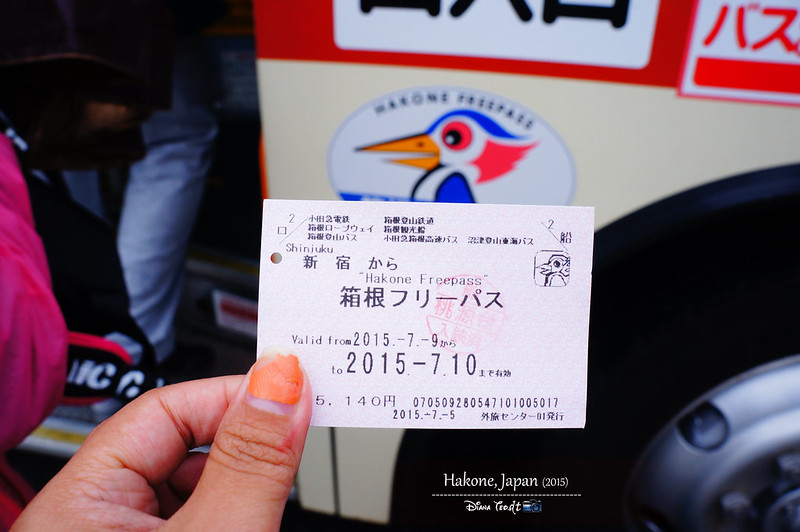
#3: 2-Day Hakone Freepass which we purchased in 2015
WHAT TO DO & SEE IN HAKONE
So now we have Hakone Free Pass, what's next? Once we alighted at Odara Station, we catch the Hakone Tozan Train departs from Hakone-Yumoto Station to Gora Station. Hakone Tozan Train is the only mountain train in Japan and during the summer time, you will get to see the hydrangeas along the Hakone Tozan Railway line in full bloom. During this period, the Hakone Tozan train is nicknamed the “Hydrangea Train.” The ride from Hakone-Yumoto Station takes about 40 minutes to arrive at the final station, Gora Station. The funny thing about this train is that halfway up the line, the train switch to reversed travel direction couple of times. Only on my second ride on Hakone Tozan Train, I realised the track was built in Z line, instead of straight. No wonder it keep reversing, then going forward, reversing, going forward and repeating for several times.
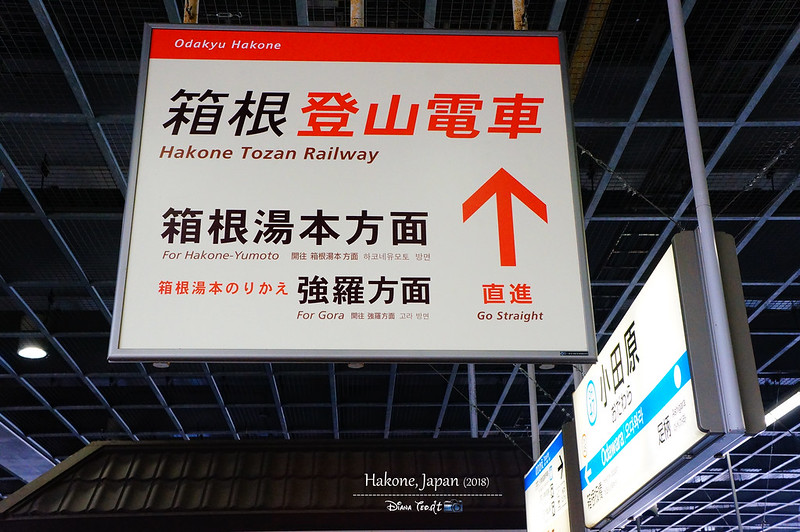
#4: Hakone Tozan Railway
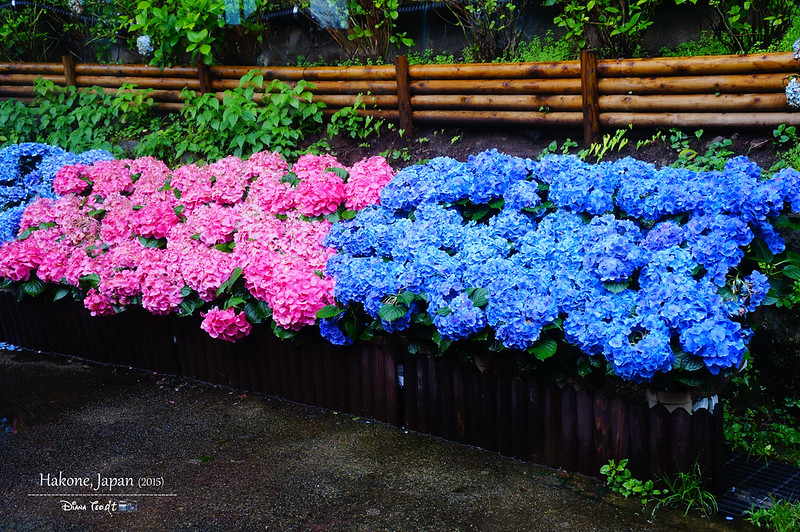
#5: The hydrangeas along the Hakone Tozan Railway line in full bloom during the summer time.
Then in Gora Station, we continue by hop-on into the Hakone Tozan Cable Car to Sounzan Station. A distance of 1.2 kilometers, in 10 minutes between Gora Station to Sounzan Station, the cable car races effortlessly up the steep slope, and even the station platform at the top is sloping.
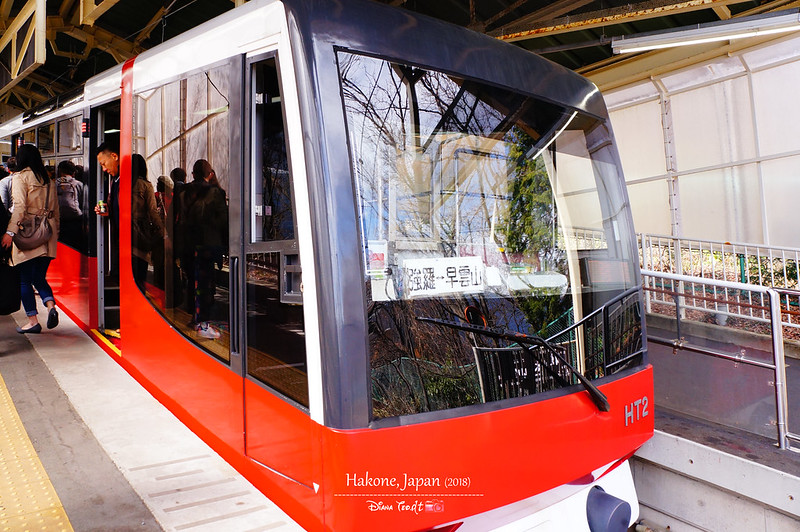
#5: Hakone Tozan Cable Car from Gora Station to Sounzan Station.
Next, we take a ride on Hakone Ropeway from Sounzan Station to Owakudani. Bear in mind in the case when the weather is adverse, Hakone Ropeway will be suspended and that's actually happened on my first trip with my family there. Only on my second trip I able to take a ride on it. Traveling the full length of the ropeway takes approximately 30 minutes and along the journey, passengers can enjoy views of the active, sulfuric hot spring sources of the Owakudani Valley.

#6: Hakone Ropeway from Sounzan Station to Owakudani
Not just I managed to take a ride on Hakone Ropeway, I was indeed overwhelming when I finally able to witness the majestic Mount Fuji. Like finally! The ropeway ride is claimed to be one of the perfect spots if you are searching for places to see Fujisan, if visibility allows.

#7: Mount Fuji in sight during our ride with Hakone Ropeway
In Owakudani, there are shops and restaurants around the ropeway sation for you to buy souvenirs or even fill your hungry tummy. On a clear days, you can have a good view of Mount Fuji from Owakudani. One thing you shouldn't miss out when you arrive in Owakudani Station is to try the famous kuro tamago, eggs cooked in the naturally hot water, whose shells are blackened by the sulfur and which are said to prolong one's life by seven years.
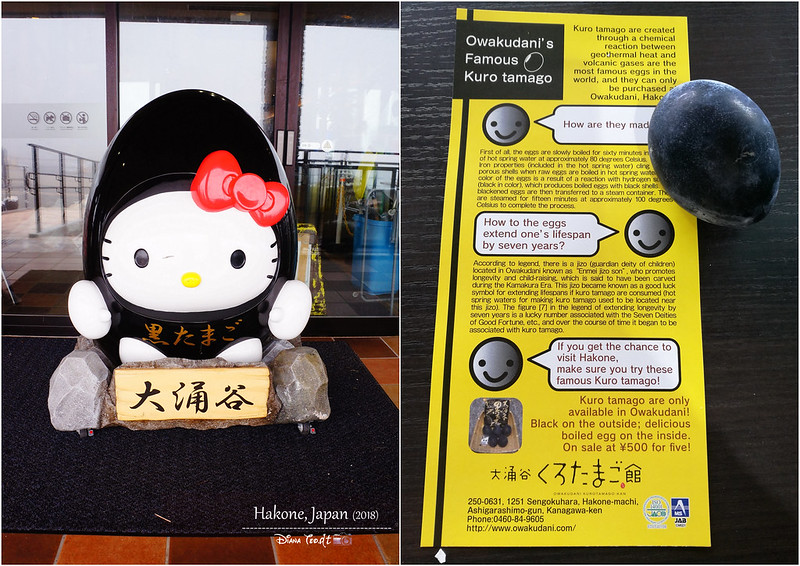
#8: Owakudani Station and its famous kuro tamago
From Owakudani Station, we continued by taking Hakone Ropeway to Togendai Station to catch a ride on the Hakone Sightseeing Cruise. Although this is my second time for taking this sightseeing cruise, but still I'm very excited. And all these rides are covered by Hakone Freepass. Therefore, it is highly recommend to get the pass before you start to explore around Hakone.
There are three different type of ships; Royal II, Victory and Queen Ashinoko.

#9: Hakone Sightseeing Cruise and this is Royal II ship.
Cruises along the Lake Ashinoko is another popular spot to view Mount Fuji in the background of the lake but unfortunately, once we arrive in Togendai, the visibility is getting poorer with the clouds blocking the whole Mount Fuji. Looks like my fate with Mount Fuji is pretty short.

#10: Cruise along Lake Ashinoko
From Togendai Pier, you can get off whether at Hakonemachi Pier or Motohakone Pier. We decided to get off at the latter one as it's nearer to the famous red torii gate.

#11: Motohakone Hakone Pirate Ship Dock
Not far from Motohakone Hakone Pirate Ship Dock, we walked over to Hakone Shrine for their famous red torii gate. It's really damn famous that you need to queue up just for the sake of few photos. Again, this is all because of the "Gram" thing. Lesson learned here - it's better to come in the early morning, or book an accommodation close to the torii gate.
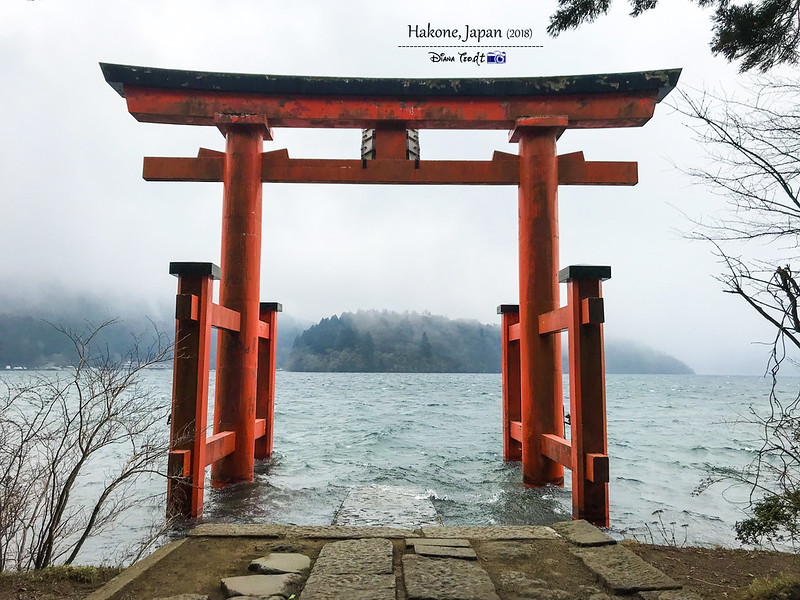
#12: Torii gate of Hakone Shrine
Our trip doesn't stop there as we continued by taking bus to Gotemba Premium Outlets. However, as this route was lead by the boyfriend, hence I wasn't able to give the proper direction how we managed to gett to Gotemba Premium Outlets from Hakone Shrine. But what I know, we need to transfer to other bus in between our journey.

#13: Gotemba Premium Outlets.
In short, this is our route looks like by using the Hakone Freepass:
1) Odawara Station → Gora Station by taking Hakone Tozan Train
2) Gora Station → Sounzan Station by taking Hakone Tozan Cable Car
3) Sounzan Station → Owakudani with Hakone Ropeway
4) Owakudani Station → Togendai Pier with Hakone Ropeway
5) Togendai Pier → Motohakone Pier with Hakone Sightseeing Cruise
And from Motohakone, you can hop on to Hakone Tozan Bus back to Odawara Station.

OUR STAY IN HAKONE
A day trip to Hakone from Tokyo is actually doable. But since I have been planning to Hakone for the second time, I decided to overnight there instead of just doing another day trip. Of course at first place I want to book those ryokans comes with private onsen and has perfect view of Mount Fuji where you can enjoying while having hot bath but it definitely will cost me a fortune. Probably wait till the day I hit jackpot and I will book it. And because of that, I booked somewhere to stay that is close to Gora Station.
#4: Hakone Tozan Railway
#5: The hydrangeas along the Hakone Tozan Railway line in full bloom during the summer time.
Then in Gora Station, we continue by hop-on into the Hakone Tozan Cable Car to Sounzan Station. A distance of 1.2 kilometers, in 10 minutes between Gora Station to Sounzan Station, the cable car races effortlessly up the steep slope, and even the station platform at the top is sloping.
#5: Hakone Tozan Cable Car from Gora Station to Sounzan Station.
Next, we take a ride on Hakone Ropeway from Sounzan Station to Owakudani. Bear in mind in the case when the weather is adverse, Hakone Ropeway will be suspended and that's actually happened on my first trip with my family there. Only on my second trip I able to take a ride on it. Traveling the full length of the ropeway takes approximately 30 minutes and along the journey, passengers can enjoy views of the active, sulfuric hot spring sources of the Owakudani Valley.
#6: Hakone Ropeway from Sounzan Station to Owakudani
Not just I managed to take a ride on Hakone Ropeway, I was indeed overwhelming when I finally able to witness the majestic Mount Fuji. Like finally! The ropeway ride is claimed to be one of the perfect spots if you are searching for places to see Fujisan, if visibility allows.
#7: Mount Fuji in sight during our ride with Hakone Ropeway
In Owakudani, there are shops and restaurants around the ropeway sation for you to buy souvenirs or even fill your hungry tummy. On a clear days, you can have a good view of Mount Fuji from Owakudani. One thing you shouldn't miss out when you arrive in Owakudani Station is to try the famous kuro tamago, eggs cooked in the naturally hot water, whose shells are blackened by the sulfur and which are said to prolong one's life by seven years.
#8: Owakudani Station and its famous kuro tamago
From Owakudani Station, we continued by taking Hakone Ropeway to Togendai Station to catch a ride on the Hakone Sightseeing Cruise. Although this is my second time for taking this sightseeing cruise, but still I'm very excited. And all these rides are covered by Hakone Freepass. Therefore, it is highly recommend to get the pass before you start to explore around Hakone.
There are three different type of ships; Royal II, Victory and Queen Ashinoko.
#9: Hakone Sightseeing Cruise and this is Royal II ship.
Cruises along the Lake Ashinoko is another popular spot to view Mount Fuji in the background of the lake but unfortunately, once we arrive in Togendai, the visibility is getting poorer with the clouds blocking the whole Mount Fuji. Looks like my fate with Mount Fuji is pretty short.
#10: Cruise along Lake Ashinoko
From Togendai Pier, you can get off whether at Hakonemachi Pier or Motohakone Pier. We decided to get off at the latter one as it's nearer to the famous red torii gate.
#11: Motohakone Hakone Pirate Ship Dock
Not far from Motohakone Hakone Pirate Ship Dock, we walked over to Hakone Shrine for their famous red torii gate. It's really damn famous that you need to queue up just for the sake of few photos. Again, this is all because of the "Gram" thing. Lesson learned here - it's better to come in the early morning, or book an accommodation close to the torii gate.
#12: Torii gate of Hakone Shrine
Our trip doesn't stop there as we continued by taking bus to Gotemba Premium Outlets. However, as this route was lead by the boyfriend, hence I wasn't able to give the proper direction how we managed to gett to Gotemba Premium Outlets from Hakone Shrine. But what I know, we need to transfer to other bus in between our journey.
#13: Gotemba Premium Outlets.
In short, this is our route looks like by using the Hakone Freepass:
1) Odawara Station → Gora Station by taking Hakone Tozan Train
2) Gora Station → Sounzan Station by taking Hakone Tozan Cable Car
3) Sounzan Station → Owakudani with Hakone Ropeway
4) Owakudani Station → Togendai Pier with Hakone Ropeway
5) Togendai Pier → Motohakone Pier with Hakone Sightseeing Cruise
And from Motohakone, you can hop on to Hakone Tozan Bus back to Odawara Station.

Credit to Odakyu official website
A day trip to Hakone from Tokyo is actually doable. But since I have been planning to Hakone for the second time, I decided to overnight there instead of just doing another day trip. Of course at first place I want to book those ryokans comes with private onsen and has perfect view of Mount Fuji where you can enjoying while having hot bath but it definitely will cost me a fortune. Probably wait till the day I hit jackpot and I will book it. And because of that, I booked somewhere to stay that is close to Gora Station.


Hakone Gora Onsen Aoiso
Room Rate: RM354 for Japanese Western Style Room with Shared Bath
Pros: 5-minute walk from Gora Station and a minute's walk to Gora Park. There is a convenience store (Daily Yamazaki) nearby this hot spring inn.
Cons: The room only comes with toilet but no bathroom. So if you want to take a bath, you need to go to the communal bathhouse where you will bath along with the rest of the hotel guests. Fret not, there's a separation room for gentlemen and ladies.
But honestly, I do enjoy the onsen especially the outdoor type. For the sake of Gram, I woke up as early as 5am cause that's the only time where no one but just me having my own sweet time soaking in the onsen while enjoying the nature scenery.
Conclusion, if you are choosing between a visit to Hakone or Lake Kawaguchiko the main factors you should consider are the views of Mount Fuji, access, and opportunity to do other things while there. Lake Kawaguchiko might has an amazing view of Fuji, but is limited in other things to do, and may not be convenient in terms of transportation. Whereas for Hakone, besides it is easy to visit and ideally fit into the itinerary, there's no shortage of things to do there, and not forgetting the views of Fuji are pretty good too. Make a wise choice cause it is impossible to cover both Hakone and Lake Kawaguchiko on the same day.